
TL;DR: Optimizing your restaurant's inventory turnover ratio unlocks trapped cash flow and directly stabilizes your bottom-line margins. Tracking this metric provides a repeatable framework for smarter food ordering, more accurate recipe costing, and minimized waste across your entire operation.
Here is what you'll discover in this guide:
- The Sweet Spot: A healthy food turnover baseline sits between 4 and 8 times per month, meaning you completely restock 1 to 2 times every week.
- The Cash Flow Connection: Low turn rates hide excess product that spoils into a total loss, while an overly aggressive turn rate triggers mid-shift shortages and costly emergency supply runs.
- The Core Calculation: How to combine your Cost of Goods Sold (COGS) and your average inventory value to reveal your exact monthly turn rate.
- Operational Protection: Consistent tracking acts as an automated guardrail against over-ordering by aligning your next delivery truck directly with your historical POS data.
Your inventory turnover ratio is the number of times your restaurant replenishes stock over a specified period of time. It plays an important role in food ordering, recipe costing, and menu pricing.
A healthy inventory turnover ratio for restaurants usually sits between 4 and 8 times per month. This means you should completely sell through and restock your inventory roughly 1 to 2 times every single week.
Balancing your inventory turnover for restaurants is a constant tightrope walk. It directly controls your food cost and dictates your actual bottom-line margin. Let’s talk about how to build an efficient, repeatable framework for inventory management for restaurants that keeps things moving.
Why Inventory Turnover for Restaurants Dictates Your Cash Flow
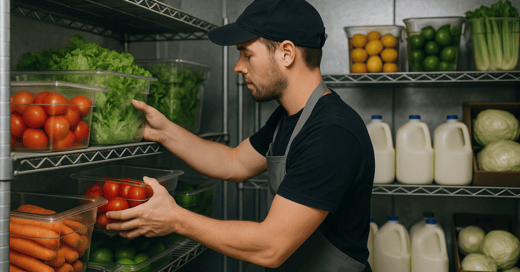
Think of your walk-in cooler as a physical extension of your bank account. Every case of ribeye or keg of IPA sitting on those shelves is cash you cannot use to clear payroll or pay rent. When inventory turnover for restaurants stalls, your liquid capital is effectively trapped on wire racks.
When your turn rate drops too low, spoilage sneaks up on your prep team. Excess product gets pushed to the back of the shelf, staying hidden until it becomes a total loss. This directly inflates your COGS and derails your margins. Keeping a tight grip on this metric is one of the most effective levers you have for reducing food waste in restaurants.
But tightening things up too much backfires. Running an overly aggressive food and beverage industry turnover rate means you run out of essential ingredients mid-shift. Those emergency runs instantly kill your plate cost and burn valuable labor hours.
How to Calculate Your Food and Beverage Metrics
To calculate your inventory turnover ratio, you will need to use the following equations:
Average Inventory = (Beginning Inventory + Ending Inventory) / 2
Inventory Turnover Ratio = Cost Of Goods Sold / Average Inventory
Example:
In January 2025, your Cost Of Goods Sold was $21,000. Your beginning inventory on the 1st of the month was worth $11,000, and your ending inventory on January 31 was worth $3,000.
Based on the above information, your inventory turnover ratio would be 3. That means you sold your entire restaurant inventory 3 times in the month of January.
Average Inventory = (Beginning Inventory + Ending Inventory) /2 = ($11,000 + $3,000) / 2 = $7,000
Inventory Turnover Ratio = Cost Of Goods Sold / Average Inventory = $21,000 / $7,000 = 3
The use of a restaurant inventory management system can automate these calculations for you, dramatically saving your team time so that they can focus on the core competencies of your restaurant that drive growth.

What is the average inventory turnover ratio for a restaurant?
Because restaurants use fresh perishable foods, you generally want to see an average inventory turnover ratio between 4 and 8 times a month.
If your ratio is lower, it usually means one of two things.
- You are overbuying ingredients, and they are sitting in inventory for long periods of time.
- Your sales are slowing down
If your ratio is higher, it means the opposite:
- You have good sales
- You are keeping inventory for short periods of time
While this may sound like a good thing, it increases the risk of you running out of ingredients and having to 86 an item.
The Real-World Benefits of a Balanced Turnover Rate
Consistently hitting your target turnover ratio gives you a clear window into how your business is actually running. When your product moves through the kitchen at a balanced, predictable pace, your forecasting becomes highly accurate. As a result, your vendor orders stay tight, and your line cooks always have what they need for a smooth service.
Maintaining this balance also means you aren't burying your capital in dead stock. Instead, you keep your cash flow fluid, allowing you to react quickly when something unexpected occurs.
Reducing Food Waste in Restaurants Through Smarter Tracking
The most immediate operational win of an optimized turn rate is reducing food waste in restaurants. By tracking your turn rate consistently, you build an automated guardrail against over-ordering. Your team starts ordering exactly what your historical POS data says you will actually sell before the next delivery truck arrives.
How inventory Management Software Can Help
While it is possible to calculate inventory turnover ratios manually, it increases the risk of error. Inventory management software helps you maintain a more accurate inventory and is programmed to make these calculations for you. This reduces the risk of manual calculation error and ensures you are using the most accurate data possible.
This will save you valuable time while helping you make the best decisions about your restaurant and inventory possible.
For more information on the inventory turnover ratio and how our software can help, please contact us today.